

![[[pictureof]]](https://dist-tutor.info/user/pix.php/12919/f1.jpg)
Меня зовут Кириллова Екатерина Викторовна.
Вам нужны консультации по Английскому языку по Skype?
Если да, подайте заявку. Стоимость договорная.
Чтобы закрыть это окно, нажмите "Нет".
Укажите реальные данные, иначе мы не сможем с вами связаться!
Отправляя форму, Вы принимаете Условия использования и даёте Согласие на обработку персональных данных
Отправляя форму, Вы принимаете Условия использования и даёте Согласие на обработку персональных данных
Yakutia has a very beautiful, diverse natural environment and the variety of vegetation in Yakutia is enormous. In this mostly flat, barren, rocky region, the most common plants are lichens and small wild flowers that bloom only for very short periods. In summer, the tundra is covered with thousands of bright flowers and emerald-green grass. Numerous insects fly around the flowers and a large number of birds enjoy summer in the tundra. Another feature of the region is the alaas ecosystem. This usually consists of a grassy, flower- filled clearing with a lake in the middle, surrounded by evergreen trees.Read more...

Yakutia has a very beautiful, diverse natural environment and the variety of vegetation in Yakutia is enormous. In this mostly flat, barren, rocky region, the most common plants are lichens and small wild flowers that bloom only for very short periods. In summer, the tundra is covered with thousands of bright flowers and emerald-green grass. Numerous insects fly around the flowers and a large number of birds enjoy summer in the tundra. Another feature of the region is the alaas ecosystem. This usually consists of a grassy, flower- filled clearing with a lake in the middle, surrounded by evergreen trees.
The tundra is the natural habitat for a wide variety of animals and plants. There are great flocks of birds, including migratory wild fowl. There are swans, geese, ducks, waders, white cranes, snow owls, ptarmigans, pintails, partridges and many other birds in Yakutia. About a hundred different species of birds nest in the tundra during summer, but in autumn half of them migrate to warmer climates.
The forest tundra forms a transitional belt between the tundra and the taiga. It is a zone of willow, pine, birch, fir and larch forests. The birch groves and pine forests provide cool protection in the heat of summer and it is pleasant to walk in the woods and listen to the birds singing. There are a lot of delightful (and almost fairytale-like) nooks in the woods with places to rest beneath the trees, near a stream or beside a brook.
There are many types of natural scenery in Yakutia. In summer, the forests and fields present a splendid mass of leaves and flowers. In autumn, they are a picture of red, gold and brown. In winter, they are bare but still beautiful. The grasslands of the river valleys and of the many dry lake beds are favourable for livestock rearing; there are vast herds of grazing animals, especially cows, horses and reindeer.
About 72% of the territory of Yakutia is covered by taiga, which in Yakutia is an endless forest, the 'lungs' of the country and full of animals of all kinds and sizes. Yakutia is home to many unique, fascinating animals. The Yakut tundra and taiga are rich in polar foxes, sables, hares, deer, bears, squirrels and many other animals both large and small. They can survive in areas which other animals and plants would find uninhabitable. The high mountains of Yakutia are home mountain goats and roe deer, while moose and elk live mainly in the northern forests, feeding mostly on the soft vegetation of the lakeside areas and the wetter parts of the forest.
In the north are the polar bears, marine animals which can if necessary pass their whole lives without stepping on land. They feed mainly on ringed seals. They have tremendous power; their huge clawed feet are well adapted for running on ice and are effective in clubbing and tearing their prey to pieces.
The white crane is a sacred bird in Yakutia. It is believed that if a person sees the dance of the white crane, they will be happy for the whole of their life. But white cranes are very shy birds and are difficult to spot. They nest deep in the tundra areas, near remote, inaccessible lakes and pools.


Yakutia is famous for its natural resources. Geology has transformed the face of the ancient northern parts of the republic. In this technological age, various geological methods are used to mine for minerals and other natural resources.
The world knew little about Yakutia until huge deposits of gold, tin, ferrous metal, diamonds and rare metals, mica, coal, gas and oil were discovered; then Yakutia became internationally famous. The republic is blessed with infinite natural resources. Read more...
The world knew little about Yakutia until huge deposits of gold, tin, ferrous metal, diamonds and rare metals, mica, coal, gas and oil were discovered; then Yakutia became internationally famous. The republic is blessed with infinite natural resources. Read more...
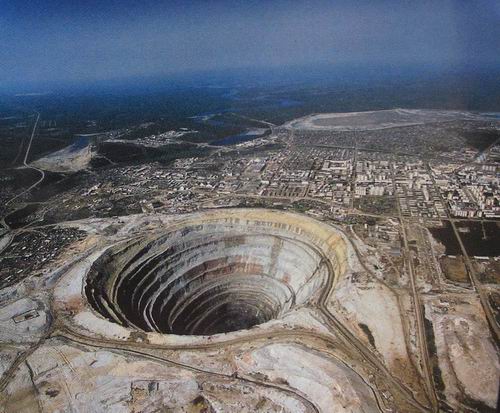
Yakutia is famous for its natural resources. Geology has transformed the face of the ancient northern parts of the republic. In this technological age, various geological methods are used to mine for minerals and other natural resources.
The world knew little about Yakutia until huge deposits of gold, tin, ferrous metal, diamonds and rare metals, mica, coal, gas and oil were discovered; then Yakutia became internationally famous. The republic is blessed with infinite natural resources. The natural riches found underground in Yakutia are almost as varied as the Mendeleev table of chemical elements. Deposits of high-grade coal and iron have been found in different parts of the country; the republic's vast iron-ore reserves make up 80% of the reserves in the Far East economic region. Coking and fuel coals are also present in significant quantities. The area has the Yuzljno-Yakutskii, the Lenskii, the Tungusskii and the Zyryanskii coal fields, where many people are employed. Such big companies as Kangalasskoye, Dzhebariki-Khaya, Sangarskoye, Neryungrinskoye, Erozionnoye, Denisovskoye and Olongrinskoye all mine coal, for export and for national use.
Gold and diamonds, which are hard to mine, are found mainly in the western part of Yakutia, where there is a comparatively high population. The Verkhoyano-Kolymskaya metallogenic province (an area containing deposits of some kind) has commercial reserves of tin, mercury, antimony, wolfram and complex ores. There are also phosphate reserves which are suitable for industrial exploitation in the Aldanskaya, Sette-Dabanskaya, Seligdarskaya and Udzhinskaya apatite provinces.
There are virgin forests where fur-bearing animals and wild game abound. The Yakut taiga is a dense forest of pine, birch, spruce, cedar, ash, elm and fir trees and is a major source of Yakutia's wealth. The forests provide wood for the growing number of homes, schools and factories. The Yakut people use wood in the furniture factories as well as in the building and construction industries. The amount of land under forestry management makes up 73% of the total area of the republic and Yakutia is one of the most important regions in Russia in terms of forestry and timber reserves. A valuable and beautiful resource, the forests are protected and respected by the people of the republic.
Water is the staff of life, as they say. The republic has 7,000 rivers with a combined length of 1.5 million kilometres. The largest river is the River Lena, which is 4,400 kilometres long and ranks among the ten longest rivers in the world. The republic has over 1,300,000 lakes, mainly shallow and of thermo-karst origin. Snow, ice and rain add a great deal of water to the rivers and lakes. To this day, some ancient practices are still in use in many parts of the republic: for example, blocks of ice are prepared for home use from which biologically active, 'living' water, which is said to have an excellent flavour, is obtained.
Million of people realise the importance of protecting the delicate natural environment of the north. As a result, nature reserves, parks and green zones have been created. In 1995, the Lena Pillars region was declared a national park in the north. The Pillars are situated on the right (eastern) bank of the River Lena about 200 kilometres from Yakutsk and the Pillars run along a stretch of 180 kilometres long. Read more...

Million of people realise the importance of protecting the delicate natural environment of the north. As a result, nature reserves, parks and green zones have been created. In 1995, the Lena Pillars region was declared a national park in the north. The Pillars are situated on the right (eastern) bank of the River Lena about 200 kilometres from Yakutsk and the Pillars run along a stretch of 180 kilometres long. The Pillars represent a continuous range of stone, needle-like columns, carved by nature over the years into the interesting shapes one sees today. The rocks which form the Pillars are bare, with only a few lichens growing in some places. But around the rocks, the wild plants of the taiga grow. The fact that the Lena Pillars have been formed of soft limestone, however, makes mountaineering in the region impossible. '
Yakutia is the only natural habitat of the Asiatic black crane, the white crane and the rose gull. Many scientists, bird-lovers and film producers visit the republic in order to see these birds in their natural environment. For this reason, with the help of the World Wildlife Fund, a bird sanctuary has been created in the north of the republic. The sanctuary is located in the marsh and the tundra and is extremely difficult to get to. Ornithologists protect the birds and study them. They ring birds and learn about migration patterns. Each year, scientists collect data about these rare birds and have got to know them very well.
Animal life in Yakutia is threatened with extinction. However, there are forest and taiga reserves where animals can live away from human contacts and where there are special zoologists who study and look after animals. Scientists introduced the yak and the buffalo from America, hoping to breed them in northern conditions. After several years, the animals have begun to produce calves. These animals are kept in favourable natural conditions and obviously feel happy in the environment that has been created for them. Reserves have not only been created for rare birds and animals in Yakutia. There are other unique natural areas that the people of the republic have made into sacred spots. The Bulus glacier is one such place. It is situated on the bank of the River Lena and it never melts, not even in summer. The clean water of the glacier runs into the river, and it provides cool, fresh air on hot summer days. In fact, a lot of children spend their summer holidays at a summer camp not far from the glacier.
The Olyokminsky Nature Reserve was established after a decision by the Council of Ministers of the Russian Soviet Federative Socialist Republic on January 3rd, 1984. The reserve is located in the south of the Sakha Republic, where the Prelensky plateau meets the Aldansky table-land. The reserve is huge and spreads over 847,102 hectares; the whole reserve lies in the permafrost area.Read more...

The Olyokminsky Nature Reserve was established after a decision by the Council of Ministers of the Russian Soviet Federative Socialist Republic on January 3rd, 1984. The reserve is located in the south of the Sakha Republic, where the Prelensky plateau meets the Aldansky table-land. The reserve is huge and spreads over 847,102 hectares; the whole reserve lies in the permafrost area. However, high levels of solar radiation and light during the summer period means that vegetation grows well and that there is a rich variety of plants, including evergreen cedar and fir trees, golden rhododendrons and red candlestick lilies known locally as sardaana. More than 600 species of vascular plants grow in the nature reserve. Of the plants in the reserve, thirty- four are on the endangered list and are protected by the state. More than forty species of mammals inhabit the reserve. These include sables, weasels and Siberian chipmunks, with the most common mammals in the regions being the sable and the brown bear. Moose and elk are also abundant here. One can often see a wild reindeer grazing in the reserve; the small musk-deer prefer the cliffs and rocks of the mountain in the taiga. In the lakes and rivers, there are river otters and also American mink (which was introduced into the south of Yakutia during the last century).
There are 180 species of birds found in the reserve. These include the Siberian thrush, scarlet grosbeak, wood-grouse, peregrine falcon and red-breasted goose. In spring and summer, the number of birds increases due
to migration. The first river floods attract hundreds of waterfowl in spring. There are eighteen species of fish in the numerous large and small rivers and springs. Grayling and lenok are found in large numbers here.
Forest covers 87% of the territory of the reserve. It has not been heavily exploited and it remains in fairly good condition. The trees include Dahuria larch, pine and birch, spruce, fir and aspen.
A network of research stations and posts has been created in the reserve. Their aim is to protect and monitor the flora and fauna in this modern age of industrial development.
The lands of the reserve are rich in mineral resources, but within the reserve their exploitation is not permitted. Within the reserve can be found ore- and gold-bearing fields, green garnet, polychrome tourmaline, shields of transparent quartz and rock crystal.


Клиентам
Репетиторам
Партнеры