

![[[pictureof]]](https://dist-tutor.info/user/pix.php/12919/f1.jpg)
Меня зовут Кириллова Екатерина Викторовна.
Вам нужны консультации по Английскому языку по Skype?
Если да, подайте заявку. Стоимость договорная.
Чтобы закрыть это окно, нажмите "Нет".
Укажите реальные данные, иначе мы не сможем с вами связаться!
Отправляя форму, Вы принимаете Условия использования и даёте Согласие на обработку персональных данных
Отправляя форму, Вы принимаете Условия использования и даёте Согласие на обработку персональных данных
This page contains a short description of history and geography of the Sakha Republic.
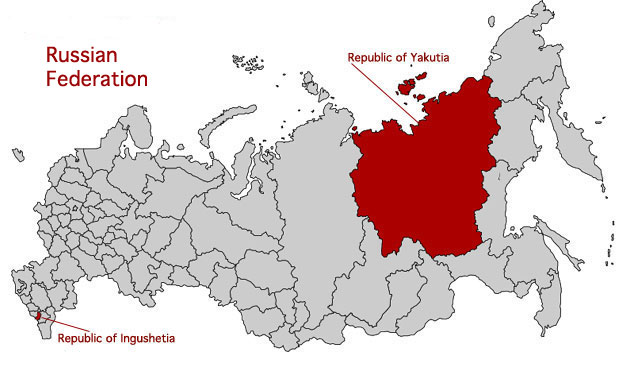
The name Yakutia was given to the Sakha Republic by its indigenous people, the people of Sakha (the Yakuts). According to the latest research, the Sakha ethnic group is quite 'young'. It was formed by the Turkic (Kurykan) tribes, which came from the south in the thirteenth century, joining with the Tungus-Manchurians who lived in the area at the time. The newcomers settled in an area with extreme climatic conditions. Together, the two groups formed an ethnic group called the Sakha and developed their own language with a Turkic base and Mongolian and Tungus influences. The Tungus influences can also be found in the traditional culture of Sakha - in things like hunting, clothes, houses and religion.
Cattle and horse breeding formed the basis of the economy, although hunting and fishing also played an important role. In addition, the ancestors of the Sakha people were skilled blacksmiths, jewellers and potters.
Agriculture in the northern areas was started by Russian peasants who first settled in Yakutia in the middle of the 17th century. This new branch of the economy developed slowly until the second half of the 19th century, when groups of Russian peasants were exiled to Yakutia as Russian Orthodox dissidents (Old Relievers, Dukhobors). They planted large quantities of wheat, oats and potatoes in the area.
The fur trade created a new type of economic situation in Yakutia. At the end of the 18th century, the state tax on fur was abolished and this helped the fur trade to develop more quickly and to become more successful.
In the 19th century, the first attempts at prospecting, i.e. the mining and production of lead, were made.
There were also some small local businesses that worked with wood, leather, iron, bronze, copper, silver, tin, lead, and gold. Another activity - mammoth tusk carving - is still quite popular in the republic nowadays.
When Yakutia joined Russia the Sakha people hoped to be given more legal rights, including the right to sell-government. However, the imperial policy of Russia towards its provinces, including Yakutia, did not encourage this, and kept Yakutia as an economically and politically backward province, deprived of many rights.
The breakthrough took place in the 20th century, when in April, 1922, Yakutia became part of the Russian Federation, with the status of an autonomous republic. Since then, the republic has been through many profound social and economic changes, as well as extensive industrial development.
A description of the Sakha Republic (Yakutia)
On September 27th, 1990, the Declaration of State Sovereignty of the Sakha Republic (Yakutia) was signed. The republic has its own constitution, a state flag and a state emblem. It is a sovereign democratic republic within the Russian Federation.
Geography
The Sakha Republic (Yakutia), a sovereign state within the Russian Federation, is situated in the north-eastern part of Russia and occupies an area one fifth of the size of the whole country. As well as the mainland, it includes several islands in the Arctic Ocean, such as New Siberian Islands and the Bolshoy Begichev Islands. The republic is bordered by two seas to the north - the Laptev Sea and the East-Siberian Sea. These are the shallowest and coldest seas of the Arctic Ocean. The republic's coastline is more than 4,500 km long in total.
The area of Yakutia is many times greater than the largest European states: it is six times the size of France and thirteen times the size of England. The distance between the extreme north and the extreme south is about 2,000 kilometres, while the distance between the extremes in the west and in the east is 2,500 km
More than 40% of Yakutia's territory lies within the Arctic Circle, and nearly all its territory is in the permafrost zone. During the summer season, the top layer of soil may thaw to a depth of 0.4 - 3.5 metres, while the ground below remains permanently frozen. The remains of prehistoric animals, such as the mammoth, the woolly rhinoceros, bison, horses and other large species are often found there. The capital city, Yakutsk, is 8,468 km from Moscow.
In the west, the republic borders the Krasnoyarsky region; in the south-west, it has a common border with Irkutsky; in the south, it borders Amursky; in the south-east it has a common border with Khabarovsky and in the east it borders the Magadansky regions.
The climate of the republic is mainly determined by its geographical situation. It is situated in the middle of the continent, which is why the warm Atlantic air streams do not affect the climate by making it milder, as they do in other areas. On the contrary, the territory of the republic is completely open to the Arctic Sea. The cold air streams from the Arctic affect the area all the year round, making Yakutia one of the coldest regions in the world.
There are three time zones in Yakutia: in the east of the republic the sun rises three hours earlier than in the west and it sets three hours later.
The republic consists of thirty-five territorial administrations: thirty-three rural districts and two urban districts. All in all, there are five cities, eight towns, sixty-five townships and about 600 villages.
This page about the nature and climate of Yakutia.
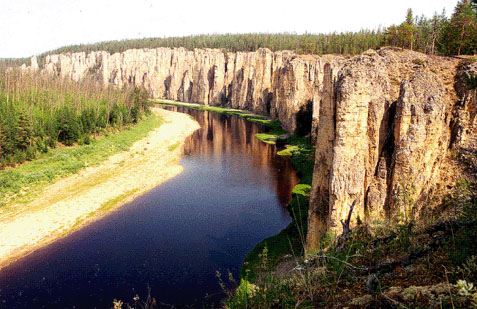

Physical features and wildlife.
As a result of both this and the size of the republic, there are four landscape zones in Yakutia: the arctic deserts, tundra, forest tundra, and taiga. Birch, pine, cedar, fir, poplar, and willow trees grow in the taiga, which covers 72% of the whole area. The main plant species are mosses, lichens, herbs, and shrubs. There are also a variety of berries: currant, cowberry, blueberry, cranberry, wild strawberry, cloudberry, bird-cherry, mountain ash and others.
A great number of large and small rivers flow through Yakutia. The main river of the republic is the Lena River, which is 4,400 km long. Other large rivers include the Aldan, the Kolyma, the Viluy, the Indigirka, and the Yana. The rivers of Yakutia flood in spring, but they can freeze right down to the river bed and stay frozen for many months during winter.
Yakutia is known as the lake district of Russia. There are over 700,000 lakes in the republic, making a total of 250-300 cubic kilometres of fresh water. Many of the lakes are rich in fish and also contain a special mud, which is said to cure a number of illnesses. The deepest lake, Sebyan-Kyol, is 137 metres deep.
In the mountains of eastern Yakutia, there are 485 glaciers (taryny) covering a total area of 413 square kilometres, which means they are an important source of water. There are 372 glaciers located in the Chersky mountain range. The biggest of these is Ulakhan Taryn
The territory of Yakutia has a complex geology, rich in natural resources. The raw minerals found in Yakutia include tin, antimony, wolfram, complex ores, gold, diamonds, fuel coals, phosphate, zeolite, oil and gas.
The wildlife of Yakutia is diverse. Among the birds found in the area are geese, ducks, swans, partridges, black grouse and wood grouse. There are also a lot of predatory birds like hawks, falcons, eagles and owls. The Red Book of Yakutia lists fifty protected species. The rarest species in the world, the white crane, nests mainly inYakutia and the Sakha believe that white cranes bring luck and happiness.
All species of wildlife in Yakutia are well adapted to the cold climate. They have thick fur to maintain a normal body temperature and are able to save and store fat for the winter. Some species spend the winter period in a state of 'anabiosis' (sleeping or hibernation) for example, chipmunks, ground squirrels and bears.

Climate
The climate of Yakutia is best described as continental, with extremely severe, long winters and short, hot summers. Temperatures are below 0°C for six months of the year, October to March. The range between the lowest winter temperature and the highest summer temperature is 101°C. In summer, temperatures may rise up to 35°C. Due to the abundance of heat and light during summer, plants grow and mature in a short period. In the 19th century, the Russian geographer and ethnographer, Alexander Middendorf, remarked that Yakutia's climate was a perfect example of the Siberian climate.
Winter is the longest period in Yakutia. The temperature falls below zero at the beginning of October in the north of the republic and by the end of October, everywhere else. The average temperature in winter is -40 to -45°C. The coldest temperatures were registered in the two centres for extreme cold in the northern hemisphere - Oymyakon (-67.8°C) and Verkhoyansk (-67.7°C). In the continental part of Yakutia, the winters are windless; only in the New Siberian Islands and along the sea coast might the wind be quite strong (up to 25-30 metres per second). Snow falls in the New Siberian Islands at the end of August, while in the rest of the republic it usually starts in October and continues for 220-250 days. The cold air stays in the river valleys and lake hollows and turns into a thick icy log, which covers the trees and bushes in a white milky 'coat'. The nights are long and dark. The long winter nights occur in the regions that lie within the Arctic Circle, where it is dark for twenty-four hours a day for the four winter months, from November onwards. On clear frosty nights, the sky is sometimes lit up by the bright flashes of the Northern Lights. Spring is a very short season in Yakutia. The weather is usually bright and dry and sometimes the wind blows, moving the Arctic air down from the north. During April, the snow melts, and the temperature varies from -5°C in the north to +10°C in the south.
Summer begins in the central and southern regions of Yakutia at the end of May; in the north it starts in the second half of June. The hottest month of the summer is July, when the temperature may go as high as 36°C. At the same time, the cold Arctic air blowing from the north may cause night frosts. Over most of the republic, the summer is short but warm, while on the sea coast and on the islands, it is dull and windy. The sun stays high in the sky, allowing daylight in some areas for twenty hours. In the north, the sun never sets and shines brightly for twenty-four hours a day. In the second half of the summer, fog forms in the low-lying areas and it often rains. Autumn begins in September, with early frosts and rains, followed by the beginning of winter at the end of October.
In this page you can read about the population of Yakutia.


Population
Yakutia, the resident population is 949,280 according to the 2002 census. Approximately one fifth of the population lives in the capital city of Yakutsk and the surrounding district. The second most populated city is Neryungry.
The distribution of population is extremely uneven. Central Yakutia is the most densely populated region, while the population density in most other regions is very low, on average 35 people per 100 square km, although in the north it is even lower.
The most ancient ethnic group is the Yukhagir people. Sometime between the ninth and eleventh centuries, the Tungus-Manchu tribes, the ancestors of the contemporary Evens and Evenks, came to Yakutia from the Amur region. Later on, in the 13th and 14th centuries, nomadic Turkic tribes of cattle breeders settled in the area. These were the ancestors of the Sakha (Yakuts).
In the 17th century, the Russian Cossacks, traders, peasants and craftsmen came to Yakutia. Sentry fortresses, settlements and later some towns were built, the land was cultivated and arable farming was developed. The Russian system of administration affected the development of the indigenous people. One of the main results of this influence was the removal of barriers between the people of the north-east of Siberia, who had lived for centuries in isolation, and those of Russia.
The 1897 Census estimates suggest that the population of Yakutia was multinational, speaking forty-six languages including Sakha (Yakut), Tatar, Bashkir, Chuvash, Jewish, Turkmen and Uzbek.
By the end of the 20th century, the population of Yakutia was extremely ethnically diverse, with more than 110 ethnic groups. Among them, the Sakha (Yakuts), Russians and Ukrainians are the most numerous, while
the rest are considered to be ethnic minorities, including the indigenous peoples of the north: the Evens, the Evenks and the Yukhagirs.
There are more than thirty ethnic associations and unions in the republic that are represented in the Assembly of the Peoples of Yakutia. The associations and unions include the Congress of the Sakha, the Russian Community, the Association of the Northern Minority Peoples, the Ukrainian Cultural Association 'Krinitsa', the Buryat association 'Baikal', the Union of Armenians, the Moldavian Association, the Finnish Cultural Community, the Kazakh Community 'Ana Zer', the Tataro-Bashkir Community 'Yaktas', the Korean Community, the Lithuanian Community 'Gintaras', the Polish Public Association 'Polonia', and others. All of the associations aim at the preservation of culture, as well as inter-ethnic and cross-cultural cooperation.

Клиентам
Репетиторам
Партнеры