

![[[pictureof]]](https://dist-tutor.info/user/pix.php/12919/f1.jpg)
Меня зовут Кириллова Екатерина Викторовна.
Вам нужны консультации по Английскому языку по Skype?
Если да, подайте заявку. Стоимость договорная.
Чтобы закрыть это окно, нажмите "Нет".
Укажите реальные данные, иначе мы не сможем с вами связаться!
Отправляя форму, Вы принимаете Условия использования и даёте Согласие на обработку персональных данных
Отправляя форму, Вы принимаете Условия использования и даёте Согласие на обработку персональных данных
Yhyakh is a traditional festival of the Sakha people. The ancestors of the Sakha celebrated Yhyakh on June 21st and 22nd - the summer solstice. Since 1991, June 21st has been an official holiday in the Sakha Republic.Read more...

Yhyakh is a traditional festival of the Sakha people. The ancestors of the Sakha celebrated Yhyakh on June 21st and 22nd - the summer solstice. Since 1991, June 21st has been an official holiday in the Sakha Republic.
According to the old cattle-breeders' calendar, a new year began in June. It coincided with nature waking up and was a holiday in celebration of renewal. The ancient Sakha wanted to protect themselves, their close relatives and their cattle from evil forces, and asked for a blessing from the gods of aiyy for their families and the whole tribe for the following year. According to one of the legends of the Sakha, the first man who brought people together for yhyakh was a man named Ellei.
The Sakha people worshipped the Sun, which is why the colour white, the colour of the sun, is so important in Sakha rituals. Traditionally, the festival is opened by the 'white shaman', an elder dressed in white clothes. He is accompanied by eight girls wearing white dresses, and nine boys.
The Yhyakh ritual consists of three parts. The first is the most important one. It involves holding kumis (fermented mare's milk) and praising the supreme white creator, identifying him with the Sun. There is a special place for the ritual in the middle of the Yhyakh field, which is decorated with birches and ropes interlaced with black and white horse hair, pieces of birch bark and scraps (salama). The white shaman sprinkles kumis for the gods and spirits and asks them to send plenty of green grass to the pastures, to ensure the cattle and horses breed well and to take care of those present.
The second part of the Yhyakh takes place in the open air in the presence of numerous people sitting round a tusulge (a place where a feast takes place). Special wooden vessels (chorons) are used for drinking the kumis and drinkers are supposed to leave some kumis in the
bottom of the choron, because it symbolises plentiful supplies and also the prosperity of the host. According to the tradition, you should not 'drink' all the riches of the host.
The third part of the Yhyakh consists of games, sports competitions, horse racing and singing contests, the narration of folk tales and the national circle dance, ohyokhai. The national form of wrestling, khapsagay, is very popular and attracts a large audience. Another national sport is m^s-wrestling (stick pulling), in which two participants each try to pull the wooden stick over to their own side. Jumping contests are another specific attraction.
But the most fascinating event is the ohyokhai song competition. People sing and dance in a circle, which denotes the year's cycle. The singers start one after another and people repeat in chorus while dancing.
During the festival, people wear national dress decorated with fur, beads and embroidery, and they eat traditional dishes. The festival continues for three days and nights. People stay out all day and night and early in the morning they watch the rising sun, taking energy from it for the whole year.


One of the most important pieces of Sakha folklore is the epic literature represented by Olonkho. Olonkho consists of a great number of lengthy legends, which reflect the Sakha cosmology and their religion.Read more...

One of the most important pieces of Sakha folklore is the epic literature represented by Olonkho. Olonkho consists of a great number of lengthy legends, which reflect the Sakha cosmology and their religion. According to Sakha cosmology, the world consists of three layers: the Upper World (the Heavens), where the Yurung Aar Toyon (the Great White Lord) and other gods live, the Lower World, the world of evil, and the Middle World, where people live. In the centre of the Middle World, there is the sacred evergreen tree, Aal Luuk Mas, a home for the goddess who is the Mistress of the Earth -Aan Alakhchyyn. The Lower World is hidden behind the mountains, far up in the north, where the Arctic Sea lies and where the sky is dark and gloomy. The inhabitants of the Lower World are cunning, treacherous and elusive. The inhabitants of the Middle World are noble warriors who are incredibly strong, handsome and wise. The view of women found in Olonkho is usually idealistic. They may be the brides, wives, sisters or mothers of the main hero. They are beautiful and kind and fight evil. The image of the woman however, is more diverse than the image of the male hero.
There are picturesque descriptions of landscapes, homes and battles. Special attention is paid to horses. According to the Sakha tradition, the horse is a sacred animal. It can speak and it understands human language.
The language of Olonkho is very rich in symbols, numerous epithets, comparisons and repetitions. Olonkho is not merely narrated by olonkhohuts (performers) but is performed like a piece of music. It is the melody that creates the artistic image. Each character of the Olohnko is characterised by a peculiar traditional melody. The Olonkhohuts are gifted people who have to have a very good memory in order to remember up to 20,000 lines of poetry and to perform the epic poem for several days and nights. In addition, they should have a strong, expressive voice and excellent dramatic skills.
In 2005, UNESCO proclaimed Olonkho a masterpiece of the oral and intangible heritage of humanity. This prestigious status is usually awarded to important items from a nation's cultural heritage, such as oral traditions, music and dance, rituals and mythology, traditional knowledge and customs.
The khomus (also known as a 'vargan' and 'mouth harp') is the main musical instrument of the Sakha people. It is a small, flat, metal instrument with a reed in the middle.Read more...
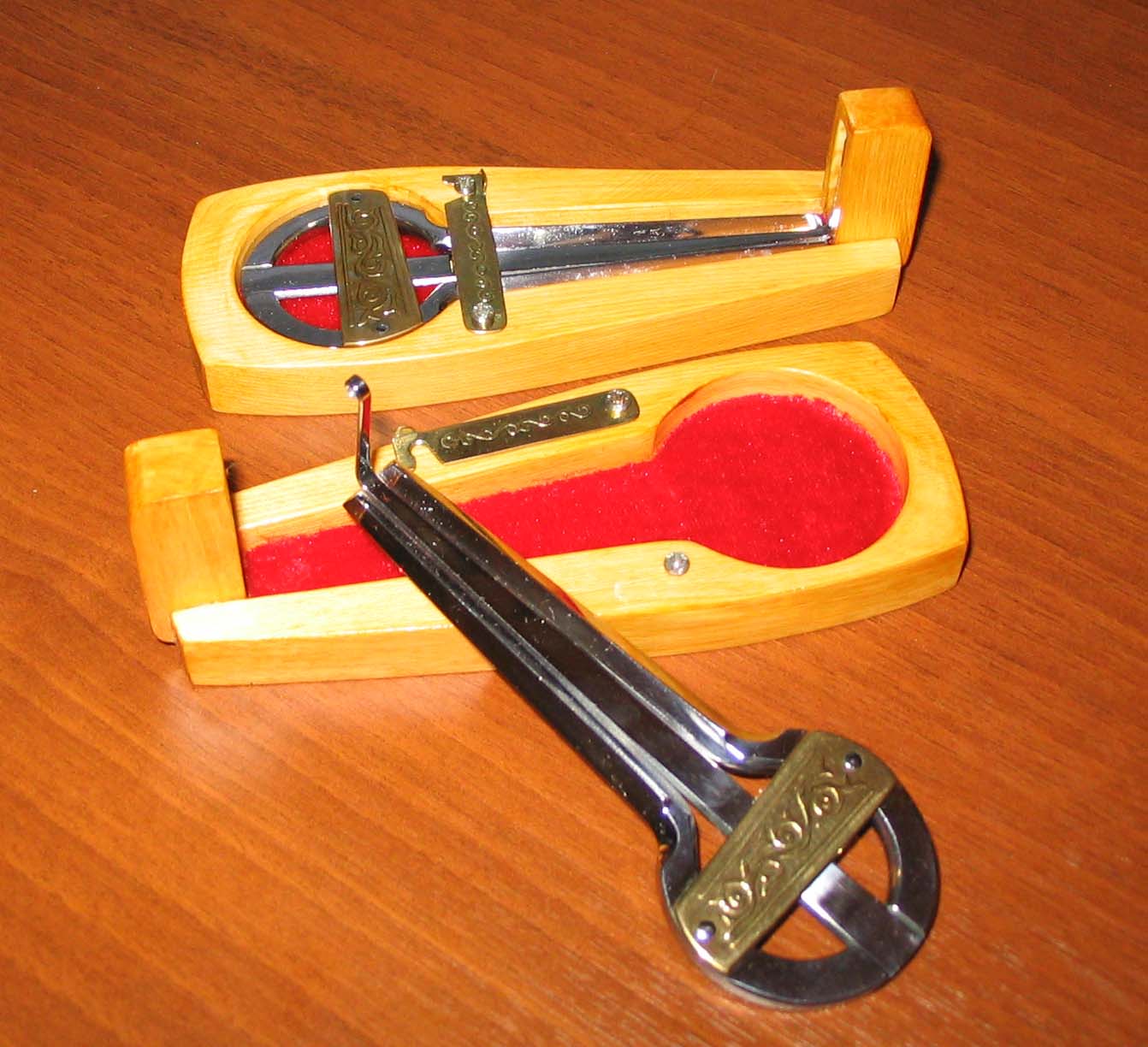
The khomus (also known as a 'vargan' and 'mouth harp') is the main musical instrument of the Sakha people. It is a small, flat, metal instrument with a reed in the middle. There are various kinds of Sakha mouth harp - a thin wooden version, one made with a flat bone frame and a reed, a metal frame with the two reeds and so on. According to tradition, it was mainly women who played the khomus in the past, producing widely-known melodies. Melodies that imitate natural sounds were very popular among khomus players - the cuckoo, the skylark, geese and horses to name a few.
Nowadays, republican and international festivals in khomus music for children and adults and for family groups and solo performers are organised. Khomus music has become a part of the curriculum in some schools too.
About 5,500 vargan are displayed at the Museum of the Mouth Harp in Yakutsk, the only museum of this kind in Russia. The museum was opened in 1991 on the initiative of Ivan Egorovich Alexeyev, President of the International Centre of Khomus Music; his private collection of khomuses formed the basis of the museum's exhibits. The museum has three exhibition rooms with displays of Sakha, Asian, European and American mouth harps. The Sakha khomus exhibition room also has extensive
information on the Sakha mouth harp experts who produced this musical instrument. The Asian room contains the Altai, Bashkir, Tuva, Kirkiz, Kazakh and Japanese mouth harps. The mouth harps on display are made from different materials - bamboo, wood, ivory and metal.
The world's best mouth harp performers come from the Sakha Republic. Among them are Spiridon Shishigin, Pyotr Ogotoyev, Albina Degtyareva and others. Albina Degtyaryova is a leading khomus performer with the Ayarkhaan ethnic group. The group has taken part in many international ethnic music festivals in Russia and other countries and is recognised as the best, not only among the Turkic people but also in Russia as a whole. The music performed by the group is very beautiful. It is impossible to describe it in words; it has to be heard. One present-day Russian music critic, Artyom Troitsky, has said of the group: 'This is greater than the orchestra'. Once during the ethnic music festival in Khakassia, the group went on a tour to the Salbyksky burial mound. A herd of horses were grazing peacefully there, but as soon as the khomus performers began to play their music, imitating the neighing of a horse, the wailing of the wind and the clattering of horses' hooves, the horses turned their heads to the performers and after a few seconds started to 'dance' to the music...
The Sakha people believe that the sounds of the khomus can awaken the ancient memory of the people, and they say the sound gives energy to listeners and can bring relief from stress and disease. The magic sounds of the khomus...

Food has always been one of the most important things in the life of the people of the north. Obtaining it always called for hard work and having plenty of food always brought great joy.Read more...

Food has always been one of the most important things in the life of the people of the north. Obtaining it always called for hard work and having plenty of food always brought great joy.
The main occupation of the Sakha living in the central and southern regions of Yakutia was horse and cattle
breeding. In the north, the people reared reindeer. The local economies determined the different kinds of local food, which mainly consisted of dairy produce and meat. The long winter, which lasted for seven months, meant that people had to work hard during the short summer in order to prepare for the long cold period. They stored hay to feed the cattle during winter, collected berries and herbs, grew potatoes and grain. The low temperatures in winter allowed them to store meat and fish.
The Sakha food is not as meagre as it seems at first sight. It is plain but fresh, tasty and filling. The records of people who lived in Yakutia in the last century show that dairy produce was the staple food, followed by vegetables. Meat was mostly consumed in winter, when the body needs a lot of protein during the cold period, and was simply boiled, without any spices or flavouring. Foul meat was preferred to beef because of its taste and its health-giving properties. In summer, during the celebration of Yhyakh, guests were treated to kumis, fermented mare's milk. This was believed to be the drink of warriors which, it was said, got rid of stress, provided energy and gave general relief and health. Nowadays, kumis is used in medicine medicine to treat pneumonia and other lung diseases.
Nowadays, some traditional Sakha dishes are still very popular among the people of the country. These are: foul meat; horse ribs, known as oyogos; frozen horse liver, which is eaten raw with salt, pepper and greens; blood pudding; slices of frozen white fish, served raw with spices, called stroganina. In the villages, the families which keep cattle have whipped fresh cream for breakfast with wild strawberries or blueberries. They can also have home-made curds (yedegey) and cream. Red whortleberry, cranberry, black- and redcurrant jam and juices all provide a good supply of vitamins.
There are several restaurants in Yakutsk with regional menus featuring Sakha traditional dishes. They include mouth-watering reindeer meat, reindeer tongue, unleavened Sakha bread, flour porridge (salamat), oyogos, smoked white fish known under the local names omul and chir, baked omul served in salamat in a pot, and many more!


Клиентам
Репетиторам
Партнеры